AI did not just make coding faster. It moved the line between what you buy and what you build. Everything teams still rent from vendors on top of their own data now takes a few hours to build — and gets customized for you, not for somebody else's roadmap.
Every build-versus-buy decision you have ever made contained one number: how long it would take us to build this ourselves.
Everything else — seat price, integration work, roadmap risk — was weighed against that number. It was the anchor.
That number fell by an order of magnitude in about two years, and almost nobody re-ran the arithmetic. Teams still rent point solutions priced against a world where an internal screen cost two weeks of somebody's quarter.
The seat price was never what you were paying for. You were buying somebody else's two weeks.
The speed-up is not evenly distributed
Every product team ships two frontends: the app the customer opens, and the pile of screens your own team lives in — the CMS, the table where a moderator kills a spam ring, the toggle that turns a feature on for five percent of users, the log that answers who refunded this, and when.
They are both React. They both render tables. And they have almost nothing in common, because what makes customer-facing frontend slow was never the code: change one button label and design signs off, product checks the funnel, localization runs eighteen dictionaries, QA finds a cheap Android phone, and on mobile a store review turns a ten-second edit into three days.
A model writes that component in twenty seconds. It cannot attend the meeting.
The customer surface stays slow, and mostly that is fine. It is product-driven: product decides what to show, design decides how, and that is other people's judgment — the thing you were paying for. Generating code speeds up none of it. The internal surface carries none of that ballast. It is not product-driven but capability-driven: what the team needs to be able to do to the system. That is where the order of magnitude lands, and where you have been signing contracts.
An internal console inverts every one of those properties
The user is your colleague, sitting twelve feet away, and requirements arrive in one sentence from the person who will actually use the screen. There is no brand: consistency matters, taste does not, and a table that looks like every other table is a feature. There is no localization, no SEO, no bundle budget, no A/B test, no store review. Deploying is a container restart.
And the spec is already written. It is called your database schema.
That last one is the whole argument. Admin screens are overwhelmingly a projection of a data model: list, filter, detail, edit, act, log. Give a model your schema, your REST contract and one existing screen, and it has what it needs to produce the next screen end to end — route, page, permission check, tests. Tests especially: seed data is deterministic and nobody pixel-peeps an empty state.
A vendor selling into that surface is selling you a generic projection of a schema they have never seen. You have the schema.
The renewal email is the only part of this that is still on last decade's schedule.
The capabilities nobody thought were worth a screen
The useful way to find this work: look for what is either baked into the source or paid for monthly, because somebody once decided it was not worth building.
Permissions are an isAdmin boolean sitting in a middleware. Feature rollout is a constant that needs a deploy to change, or a flag vendor with an SDK in the bundle. Content lives in rows an engineer edits at eleven at night. Spam handling is a Slack channel and vibes, or a moderation SaaS that scores messages it cannot see the context of. Who refunded this? gets answered by grepping logs at two in the morning. Dev tooling is an SSH session and a psql prompt.
We pulled every one of those out of the code and out of the invoice, and made each an actual feature of the console:
CMS. In-house, with a preview. Content is edited by whoever owns it, not by an engineer at night.
Permissions. A role × action matrix, and a screen that edits it. Every route in the project is wired to it.
Release tooling. Settings and feature flags: turn it on for five percent, roll it back in one click, no deploy.
Monitoring. Spam detection and message safety: a queue, thresholds, triage, bulk actions — all of it able to see your user table.
Audit log. Append-only: who changed what, and when, with filters and a diff view. Who refunded this is one form query, not a night in the logs.
Dev tooling. The one-off scripts, promoted to buttons that ops can press without us.
Each of those conversions removes an engineer from a loop, and none of them added a dependency.
What you are actually paying a vendor for
The invoice is the smallest line in it.
You pay in dependencies: an SDK whose surface you use four percent of, dragging a transitive tree, a peer range and an upgrade cadence that is not yours. You pay in glue: an auth integration, a webhook endpoint nobody owns, a sync job reconciling their copy of your data with the real one. You pay in seams: your moderator holds two logins, the spam signal lives in their database and the user table lives in yours, and every question that spans both becomes an export.
And you pay in ceilings: the field you need is on their roadmap for the third quarter, or it is not, and there is no version of Tuesday where you add it yourself. None of that fit the comparison spreadsheet, which only had room for the seat price and the two weeks.
Four vendors, three SDKs in the bundle, two of them pinning conflicting versions of the same library, and one deprecation notice dated the week of your launch.
Built in-house, each of those is a route, a page and a table in a schema you already run: it ships on your cadence, joins against your data, and adds nothing to package.json.
Two numbers from our own console
Hours
What
What it took
4 h
Spam detection & WhatsApp monitoring
Queue, thresholds, triage screen, bulk actions. Maintenance only ever since.
8 h
Permissions, project-wide
The full role × action matrix, the screen that edits it, and every route in the project wired to it.
Both have vendors. Evaluating either one — demo, trial, security questionnaire, data-processing agreement, procurement — would have taken longer than building the feature took. The paperwork now outruns the work, and at the end of it you own a queue that cannot see your user table.
Neither began as a ticket and neither got a mock. The moderation lead described the queue they wanted in a paragraph, and the screen matched the paragraph — on this surface the paragraph is the spec. What came afterwards was tailoring, not a project.
That is the whole loop: build in a few hours what others buy, then keep shaping it for yourselves — not for whatever the vendor decided was worth exposing in settings.
Simple enough to delegate end to end
Why this works here and nowhere else: the admin console is the one surface where a task can go to a model end to end — route to test — without a human checking every pixel. All it needs is a surface the model can read:
One page pattern, applied everywhere: list, filters, detail, action bar. The second screen is the first with different columns. Boring is generative: the more your screens rhyme, the faster each one arrives and the faster a human reviews it.
A thin, typed REST layer for admin only. Do not make the model learn your bespoke socket protocol just to render a table.
Seed data, a working login, and a compiler as the gate. A model that can open the page and click checks its own work before you look at it; tsc --noEmit and a fast end-to-end pass tell you more about an internal tool than any style review.
One acceptance sentence, from the person who asked: "I can find a user by email and see their last ten payments." Testable, prompt-sized, and written by whoever will use the screen.
Most teams are on rung two, paying for rung three.
Building it means the guardrails are yours too
This is the honest half: buying outsources some responsibility, and building hands it back. The admin console is the most privileged surface you have — it reads personal data, bans accounts and moves money — so the checklist is not optional.
Ship it separately. Own domain, own release cycle, no shared component library with the product. The day an admin tweak needs a product release, the advantage is gone.
No default secrets. A signing key with a fallback value in the repository lets anyone holding that repository mint an admin token.
Restrict the network twice, and mind the proxy. The panel and the admin API are different hosts, so allowlisting one does nothing for the other — and if the app trusts X-Forwarded-For, the client IP is a string anyone can type.
Log every mutation append-only, with the actor and the diff, and keep permissions as a reviewed matrix in code rather than a condition scattered through components.
That is a checklist, not a design review. Write it once and every generated screen inherits it; a human reads the permission check and the audit call on each merge.
Keep buying depth. Stop renting screens.
This is not an argument for building everything. Keep buying depth: payments and the compliance around them, video encoding, email deliverability, the database itself — years of somebody's specialised problem that no amount of generated code puts in your repository.
What flipped is the point solution: a thin interface over data you already own, sold by the seat, priced against two weeks of engineering that now costs an afternoon. Depth is worth renting. A screen is not.
Most teams still live the other way round: in the age of AI they pick up a ready-made solution, then spend months fighting its upgrades and its customization — and pay for that as if it were expertise. So re-run the arithmetic on every tool in your stack with the new number in it. Some contracts will still make sense; the rest have been quietly costing you flexibility, bundle weight and every question that spans two databases — while winning on a number that stopped being true.
Build it yourself again. Read the permission check yourself too.
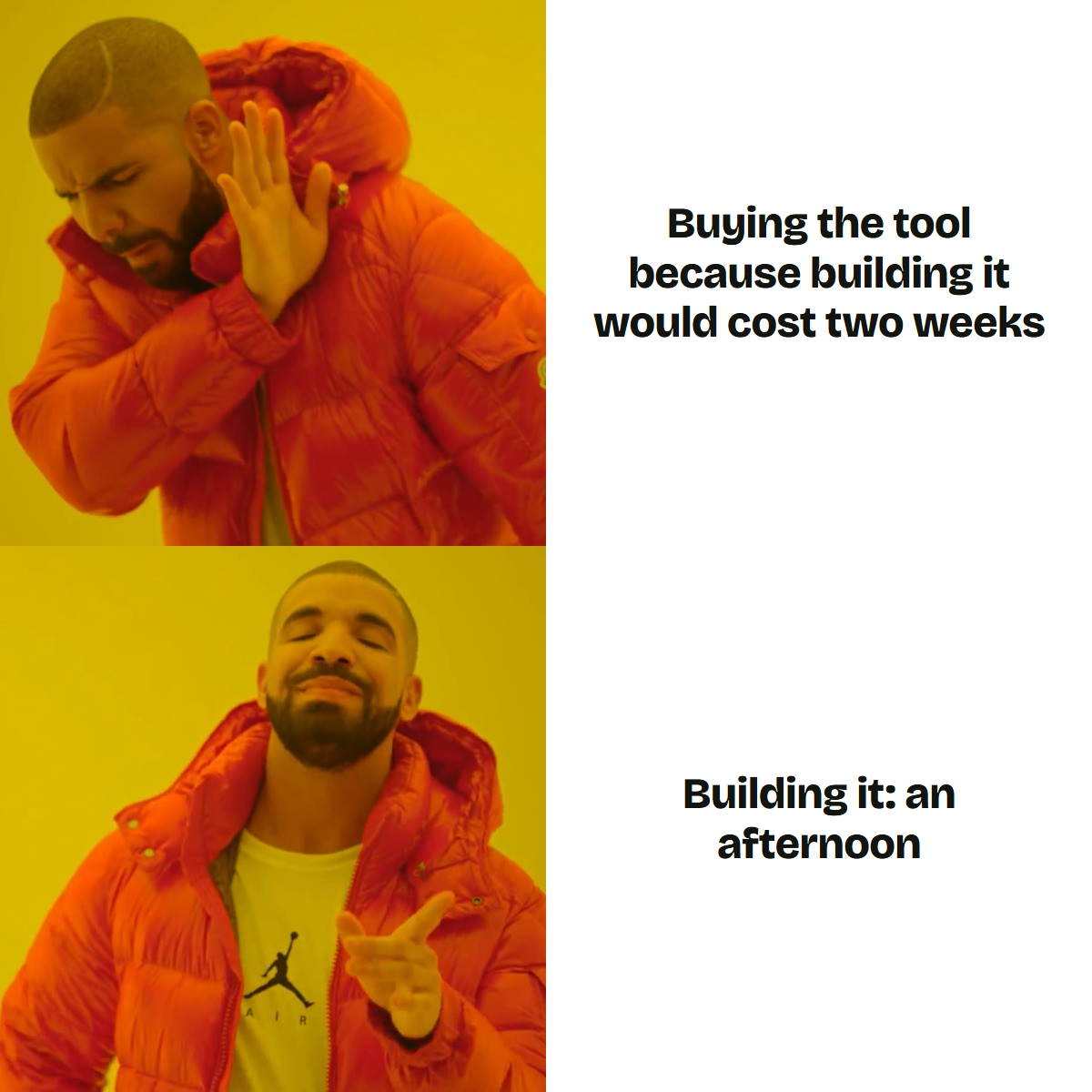
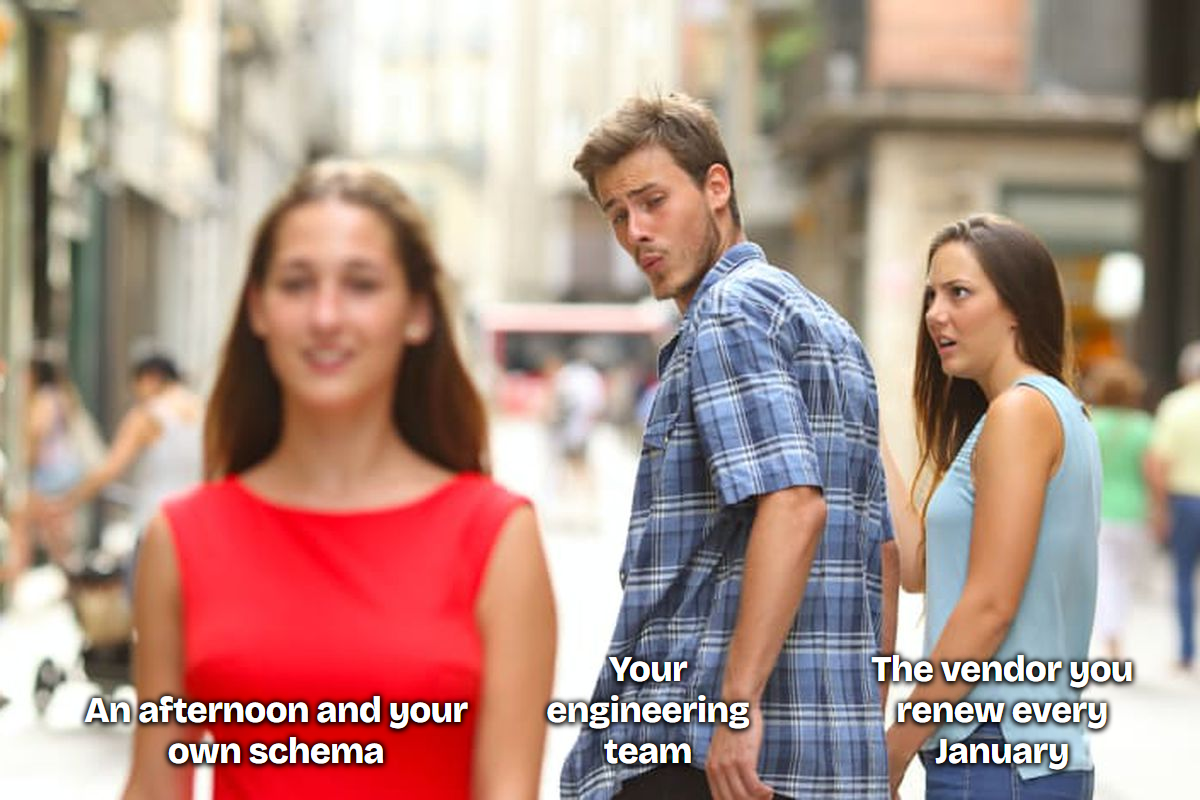
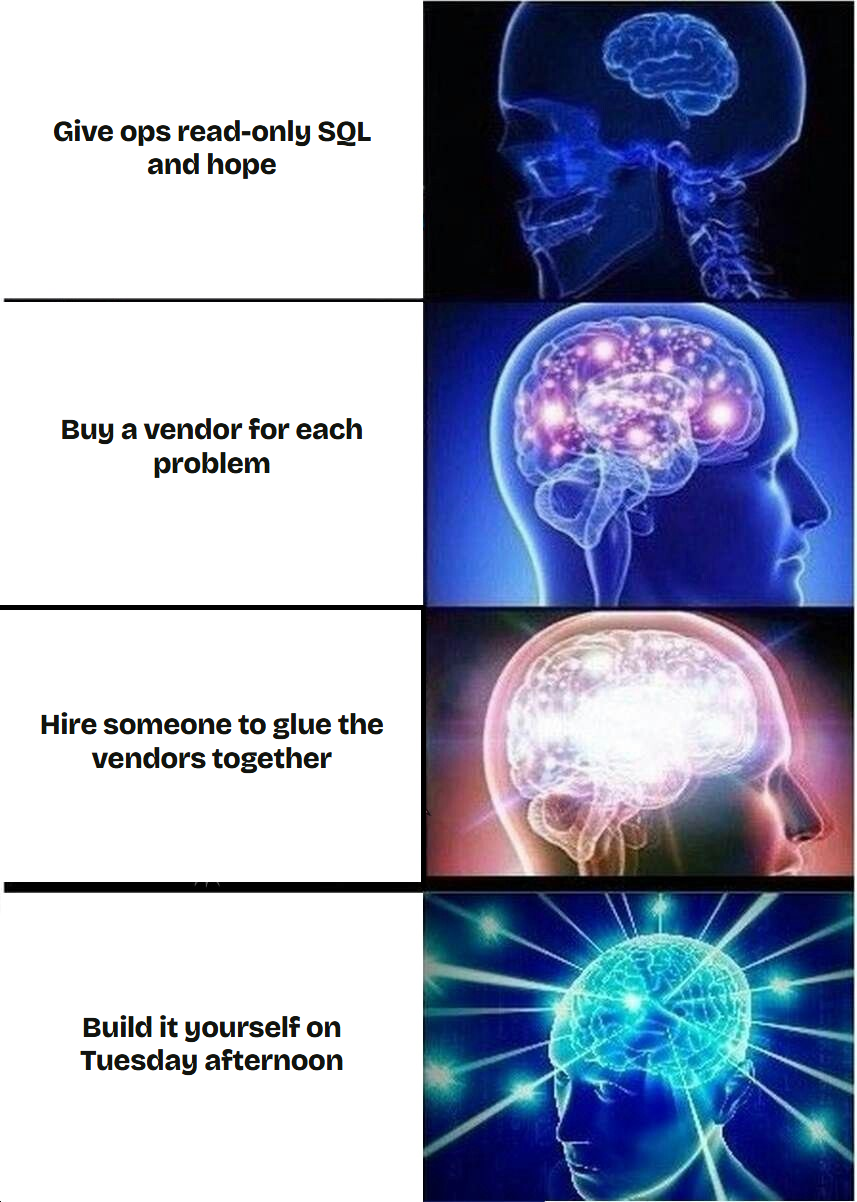
Hours quoted are wall-clock, request to first use in production. Memes rendered from blank imgflip templates (Drake Hotline Bling, Distracted Boyfriend, This Is Fine, Expanding Brain); captions ours.

 Aleksandr KhizhnyiEngineer at Kineto