How Do You Figure Out What Your Blog Is Actually About?
0
Aug 21, 2026
Short answer: not by answering values questions on a blank page.
Aug 21, 2026
Short answer: not by answering values questions on a blank page.
You find it by auditing your own archive as evidence — reading your last fifty posts for four specific audience signals (long comments, sends, DM questions, and phrases people repeat back to you). Your niche is already documented in how people responded. You just haven't read it.
You google the questions that were supposed to change everything and make you a successful creator.
What are my values? What do I do better than others? How am I useful to people? The cursor blinks.
Twenty minutes later you write: honesty, lightness, I help people believe in themselves. You read it back. It could be about anyone. You close the tab. Everything as it was.
Values exercises fail for three structural reasons, none of which are about you not knowing yourself well enough. The problem is that your own qualities are the hardest ones to see.
What comes easily doesn't feel like value. A woman who can take apart someone's wardrobe in fifteen minutes and explain why three items are fighting each other will write "diligent" under strengths. The wardrobe thing doesn't count. That's not a skill, that's just having an eye.
People don't answer these questions honestly. They answer as the version of themselves they'd like to be. "My values are freedom and mindfulness" — lovely, but the person filming in the evening is someone else entirely: tired and funny. The blog then gets built for the first one and lived by the second.
And most importantly: you've already been answering these questions for a year. With posts. You just never read the answers.
An archive audit is the practice of reading your own back catalogue as evidence — treating your posts as a case file rather than a body of work, and letting audience response tell you what your niche is instead of deciding it in advance. It is not a meditation over an empty document. It's fifty posts and four signals.
| Signal | What to measure | Why it matters |
|---|---|---|
| Long comments | Length, not count | A heart means "passing through." Three paragraphs about themselves means "landed." These cluster under four or five posts out of fifty — and never the ones you'd bet on. |
| Sends | Sends per reach | Forwarding means remembering a specific person and vouching that it'll land. An expensive action. |
| DM questions | What people ask, not what they praise | Five questions in a month about how you decided to quit your job is your topic — even if you wrote about it once, in passing. |
| Repeated phrases | What followers quote back. | There's a line your audience repeats. It's always slightly wrong and never the one you were proud of. |
Put them together, and you're left with five to seven posts where everything converges. What they share isn't a topic — it's an angle. Not "about relocating," but "about relocating without the gloss, with numbers and failures."
That's your niche. Not invented. Found.
A woman runs a food blog. Bio: recipes, family, comfort. She posts everything — breakfasts, café reviews, her kids, occasional thoughts.
She sits down with her archive and hits something strange. The recipes collect likes and silence. But under three posts where she explained why her dough didn't rise and what exactly she did wrong — three-paragraph comments and fifteen DMs.
People aren't coming for recipes. There are a million recipes online. They're coming to watch an adult take apart their own failure out loud. That's rare, because it's embarrassing.
She's about cooking mistakes, not about food. And she spent a year filming the wrong thing.
The right question is inverted: not what competitors do better, but what they don't do at all.
Standard advice says analyze your competitors and list their strengths. That always ends the same way — an hour of doomscrolling and the conclusion "theirs is better."
Open three similar accounts and read the comments, not the posts. Look for questions people ask that the author never answers. They're always there. A skincare creator gets asked what to buy on a 2,000 budget — she stays quiet, because she lives on premium brand deals. A trainer gets asked what to do about back pain — he stays quiet, because he doesn't want the liability.
Fifteen minutes in someone else's comments beats a month of watching their Reels. Pleasant side effect: you stop comparing yourself to them. There are holes there too — you were just looking at the lighting and the editing.
Sometimes. More often it means "haven't decided yet," and the difference is testable.
About lots of things is when varied topics are held together by one recognizable angle. Haven't decided is when you could distribute your posts across five other accounts and nobody would notice the swap.
Thirty-second test: show your last nine posts to someone who doesn't know you and ask them to describe you in one sentence. If they hesitate, the app will hesitate too — and it will file you under a broad topic instead. A broad topic is something a user can mute with one button, and you ride out along with it.
No. Changing your niche is normal; the failure mode is never having one.
People change, interests drift, in a year you might be about something else. That's fine and it happens to everyone. What's bad isn't changing your niche — it's not having one at all. Then every post starts from a blank page, and none of them accumulate.
Everything described here can be done by hand. About four hours: export your posts, recount the reactions, reread the comments, visit three similar accounts, answer yourself honestly.
That last item is the problem. Counting reactions is boring but doable. Answering uncomfortable questions alone is nearly impossible — there's nobody to push back.
That's why x-ray_niche in Kinetik is built as a conversation. First it reads your last fifty posts: what gets read through, what gets replied to, what gets scrolled past. Then it starts asking — but not blind. Out of the numbers it just saw.
Not "what are your values," but: these four posts got six times more replies than everything else — why did you stop writing about this?
You answer. It follows up. Where the answer is generic, it asks again, more specifically. This continues until a formulation assembles itself out of your own words and your own numbers. Along the way it shows you who's already sitting next to you and where they don't go.
At the end, you know what you're about. Not because you invented it in twenty minutes on a blank page, but because you saw it and said it out loud.
That’s exactly what X-Ray Niche in Kinetik is built to do. It treats your existing content as data, not decoration: it looks across your posts for the patterns your audience responds to, compares those signals with what similar creators are doing, and spots the angles you may have overlooked.
Message x-ray_niche in Kinetik and share your handle ↗. It analyzes your content first, then asks targeted questions based on what it finds — so your answers help turn those patterns into a clear niche and positioning.
How many posts do I need for an archive audit? Fifty gives enough signal without becoming unmanageable. Under fifty, weight DM questions and repeated phrases more heavily, since comment volume will be thin.
What if my best-performing posts are off-brand? That's the most common and most useful outcome. Off-brand posts that outperform are usually the actual brand — the archive is telling you something your bio hasn't caught up to.
Is a niche a topic or an angle? An angle. "About relocating" is a topic and describes thousands of accounts. "About relocating without the gloss, with numbers and failures" is an angle and describes one.
How narrow should a niche be? Narrow enough that your positioning sentence excludes your competitors, broad enough that a stranger can tell what category you're in. Content the algorithm can't classify can't be routed to an audience.
Can I change my niche later? Yes. Repositioning is normal and expected. The cost of having no niche is higher than the cost of switching one.
How long does an archive audit take by hand? Roughly four hours: exporting posts, recounting reactions by response rather than likes, rereading comments, and auditing three comparable accounts.
Aug 21, 2026


Send a photo with the words "Animate my photo," and Kinetik brings it to life.

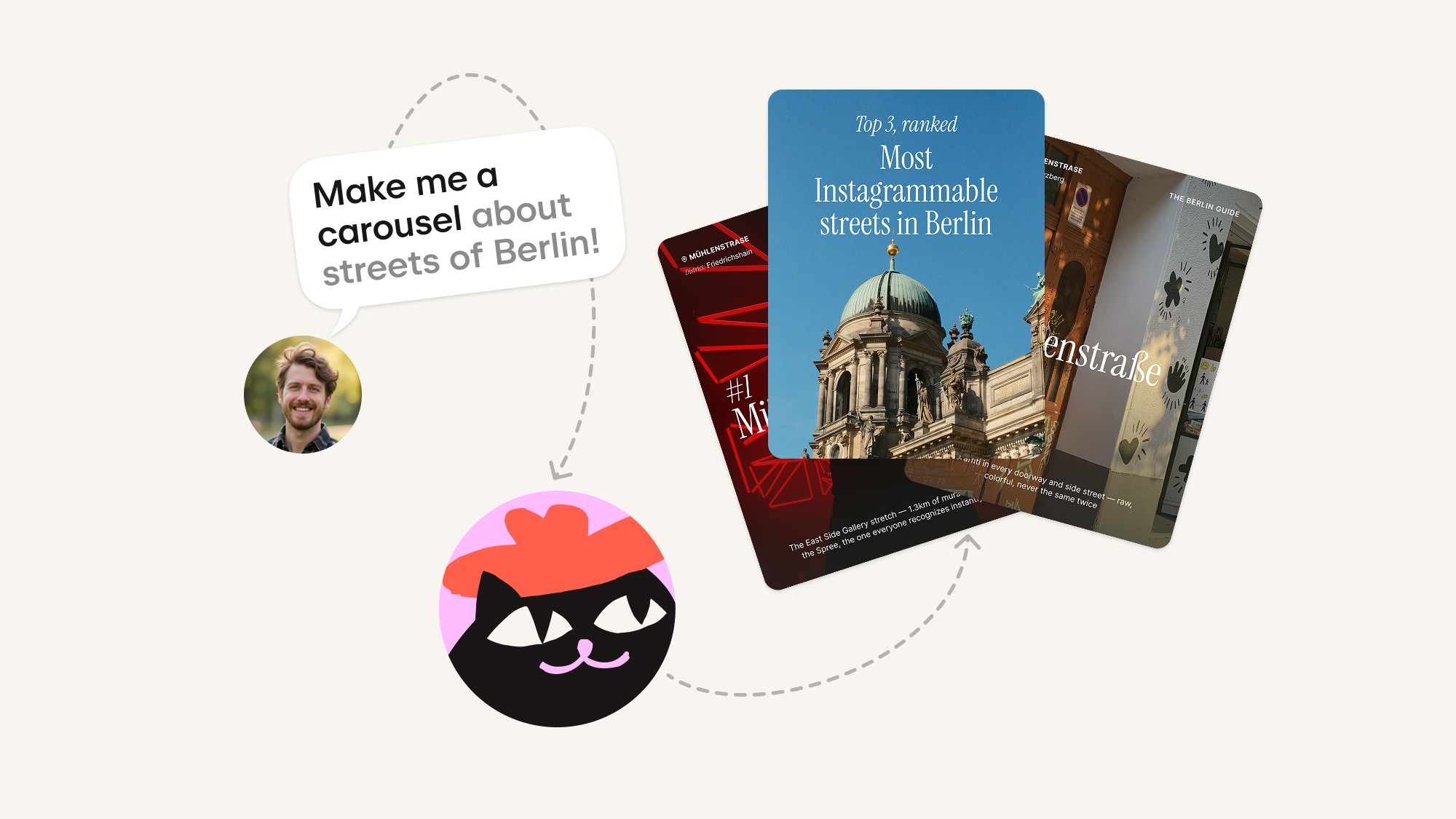
Bring a topic, and Kinetik writes the slides, chooses the images, and lays out the whole set — you just review, tweak, and publish.
AI did not just make coding faster. It moved the line between what you buy and what you build. Everything teams still rent from vendors on top of their own data now takes a few hours to build — and gets customized for you, not for somebody else's roadmap.