
From hate comments to viral content
0
 Viktoriia ErmakovaCommunity manager
Nov 10, 2026
How a Makeup Artist Doubled His Video Views
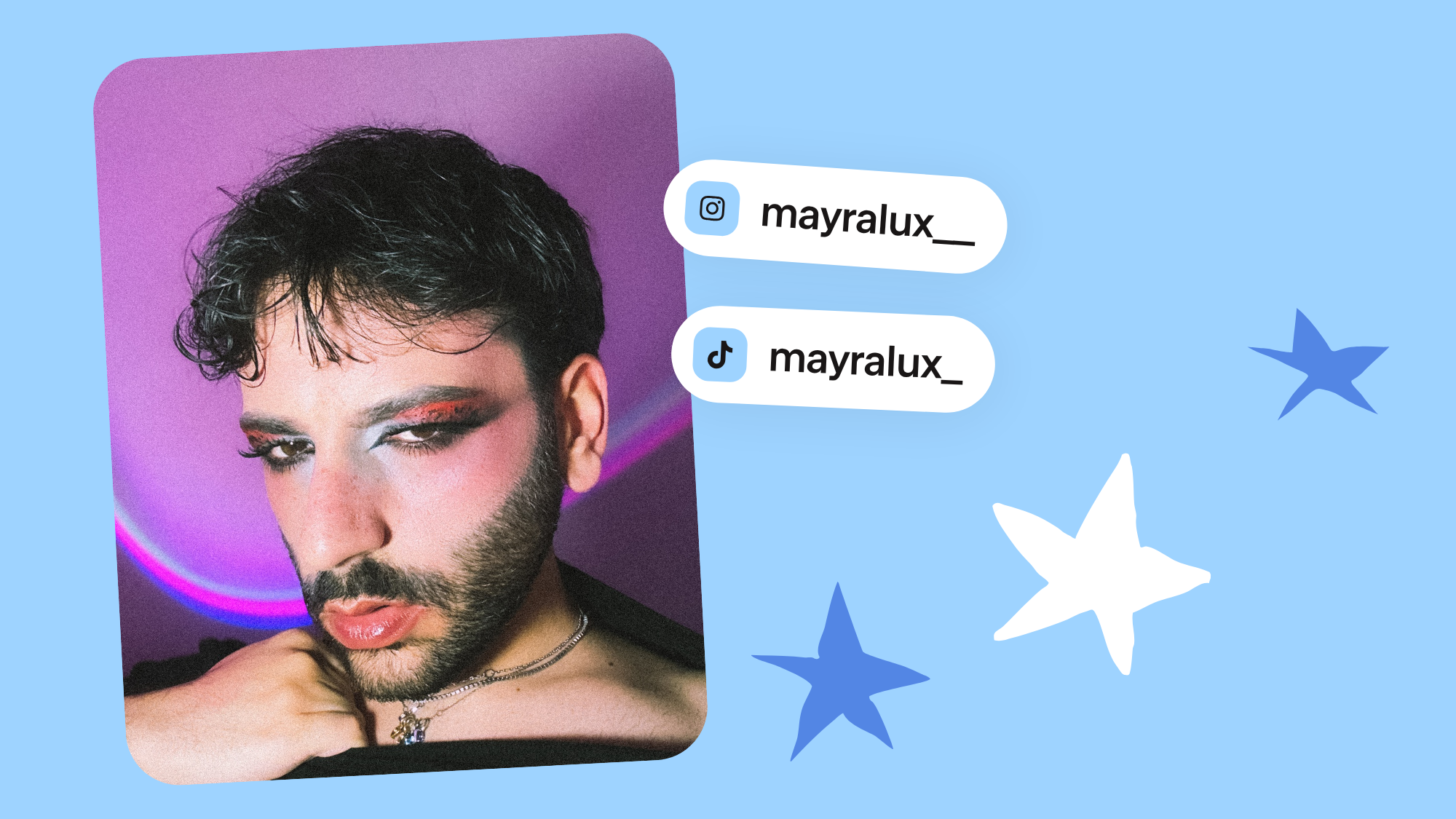 Viktoriia ErmakovaCommunity manager
Nov 10, 2026
How a Makeup Artist Doubled His Video Views
Mayra ↗ makes makeup content in Italy, without gender boundaries. That brings him a steady stream of hate in the comments, and he turns it into education: videos that start conversations and show that makeup is for everyone. Content like that takes heart. Keeping it going week after week, with brand deals, research and filming, takes a system. This is how he built one with Kinetik ↗, in his own words.
I started creating beauty content because makeup has always been a way for me to express myself creatively. Over time, I wanted to build something different in Italy: makeup content without gender boundaries.
One of the biggest challenges has been the negative comments and hate. One comment really stayed with me: someone telling me I should die, simply because I wear makeup. I started looking for other hurtful comments and found hundreds of them, all wishing me dead, just because on social media people can say whatever they want with no consequences. I remember thinking: how can something that makes me happy provoke so much hate?
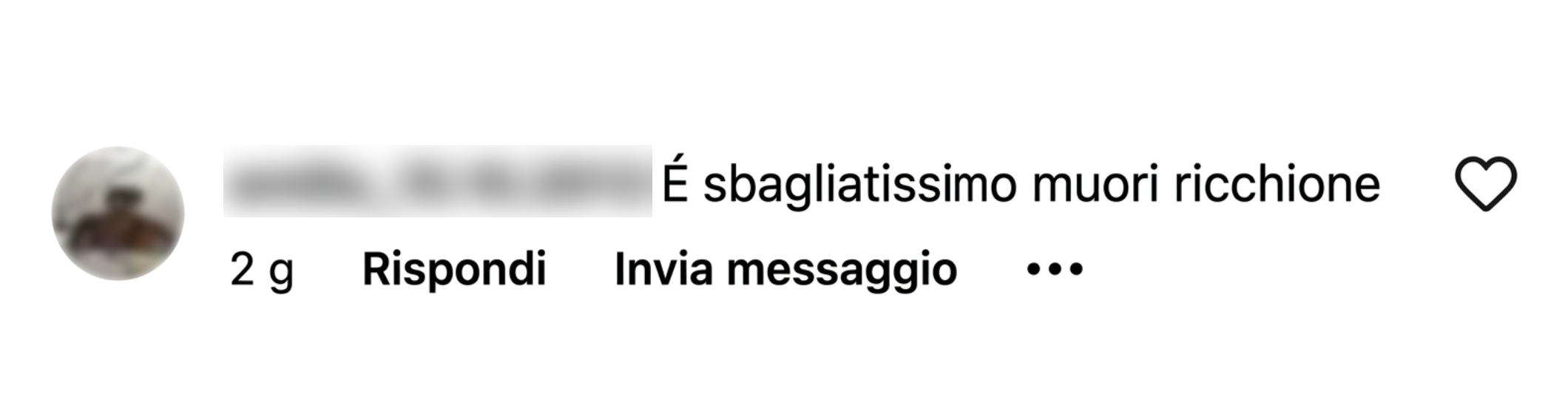 One of the comments Mayra received. It translates roughly as: "So wrong. Die, (homophobic slur)."
Instead of letting that silence me, I turned it into educational beauty content, using hate as a starting point to challenge gender stereotypes. I wanted to turn something that hurt me into something that could help others feel seen and accepted. People were shocked by the comments, but fortunately they have supported me through all of it. That's what my content is: a conversation with my audience. And the more conversations I started, the more work there was behind every video.
Behind every video there is research, planning, scripting, brand deadlines and filming. For a long time all of it lived in scattered notes, and every script meant hours of writing and rewriting by myself. I started exploring AI to make that process more efficient. I tried dozens of tools, from ChatGPT and Claude to smaller, lesser-known platforms. They could answer a question, but they didn't change the way I worked: each time I started from scratch, and nothing connected my ideas, my research and my calendar.
Kinetik ↗ was easy to get started with, and it quickly became part of my routine. What I appreciate most is that it can take even half a sentence I quickly wrote down and turn it into something structured that I then develop in my own style.
🖊️ Team's note: why an agent feels different from a chatbot
A general chatbot answers one question at a time and forgets you. Kinetik is an agent built for creators: it keeps the context of your niche, your voice and your past sessions, works with the tools you connect (like Notion), and searches the web when it needs fresh facts, such as today's prices in your country.
That's why Mayra's second, third and tenth scripts start from what Kinetik already knows about him, not from a blank page.
Here are the three things Kinetik helps me with every week. Each one is my account of what happened, followed by the team's step-by-step so you can try it on your own content.
Writing a script used to take me around four hours, because I was not just writing. I was researching ideas, analysing what worked, figuring out why some videos underperformed, and rewriting everything until it felt right for my style. Now it takes me about an hour to go from an idea to a finished script. The script feature has honestly been a game changer: I can take a random idea and turn it into a complete script with the right pacing, structure and tone for my niche, and spend the time I save on filming and creating.
Here is a real session. I sent Kinetik my list of favourite products for a winter video. It checked the prices on Italian sites, so the numbers in the script would be right, and wrote a script with a title and a hook around my list.
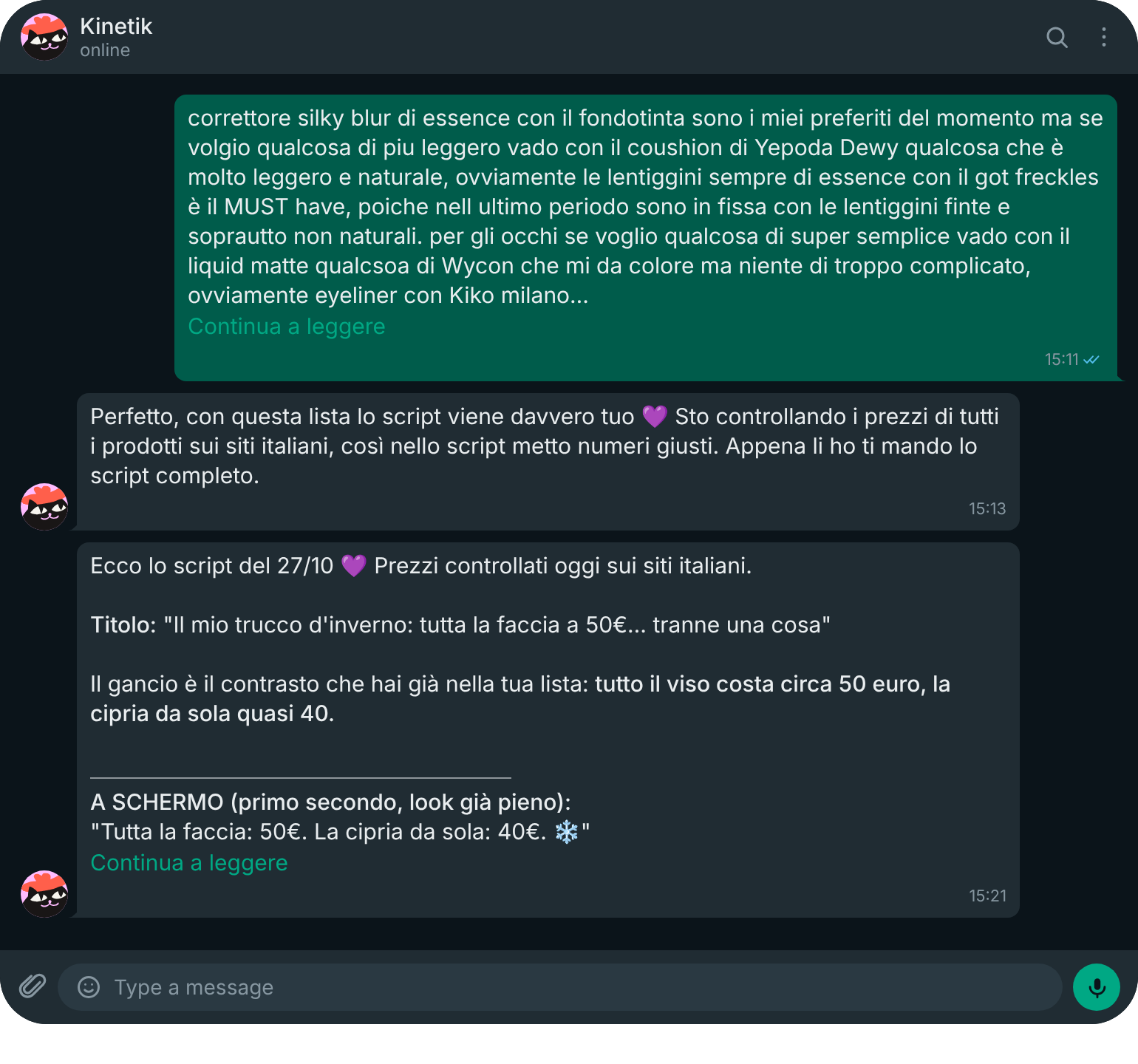 Mayra sends his product list. Kinetik checks prices on Italian sites, then sends a script with a title and a hook. (Italian)
The first version didn't feel like me. It sounded like a product showcase, not a conversation. So I told Kinetik I wanted it to feel like a video call with my best friend, where I tell the story while doing my makeup. Its answer was: "You're right, it was a shop window, not a chat." And it rewrote the whole thing.
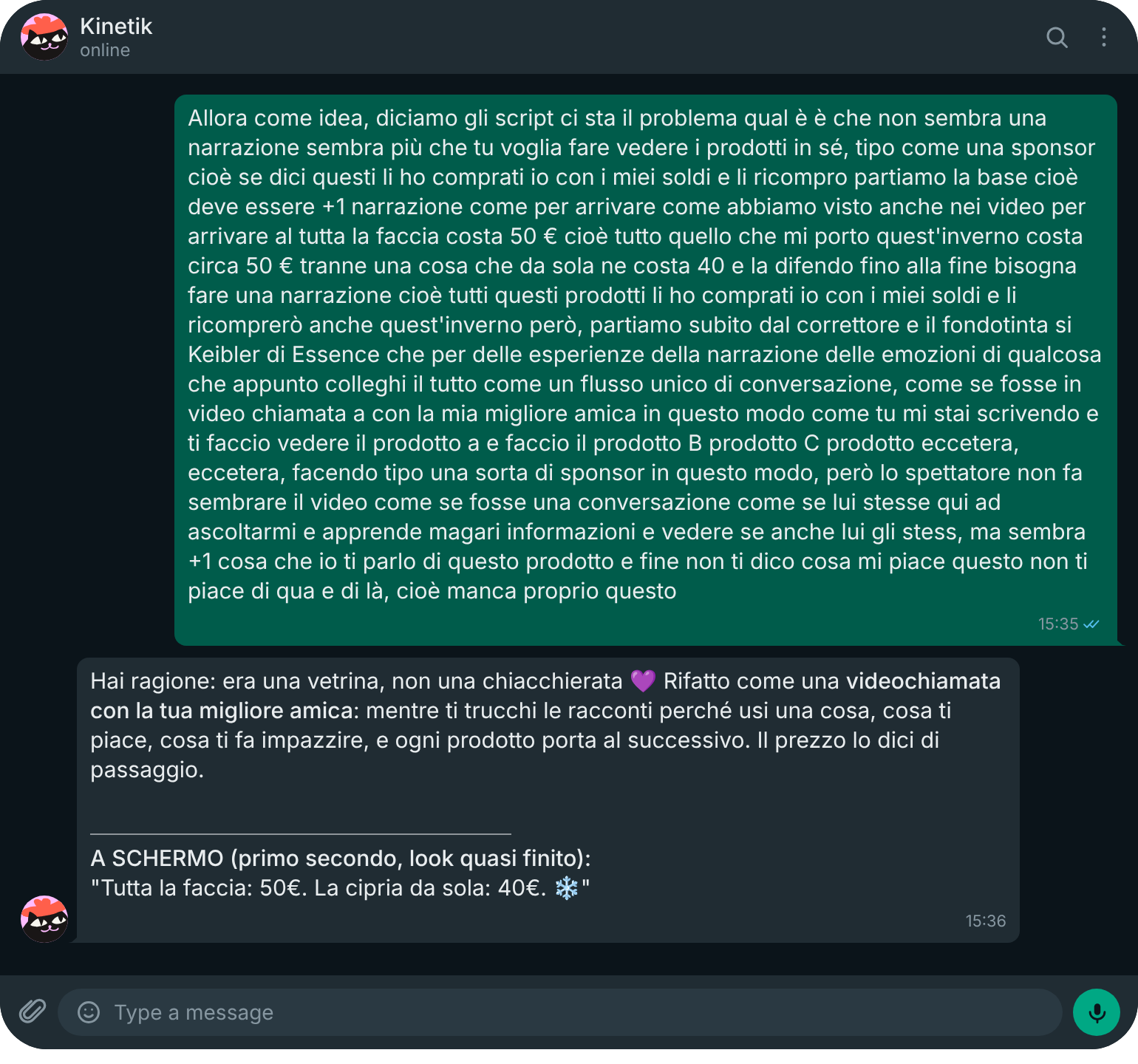 Kinetik: "You're right, it was a shop window, not a chat." Then it rewrites the script as a video call with his best friend. (Italian)
The new version connects every product to a problem or a moment from my life, includes what I like and what I don't, and mentions prices in passing. And the part I trust most: Kinetik left placeholders for my real experiences instead of making them up, and asked me which products and details to fill in.
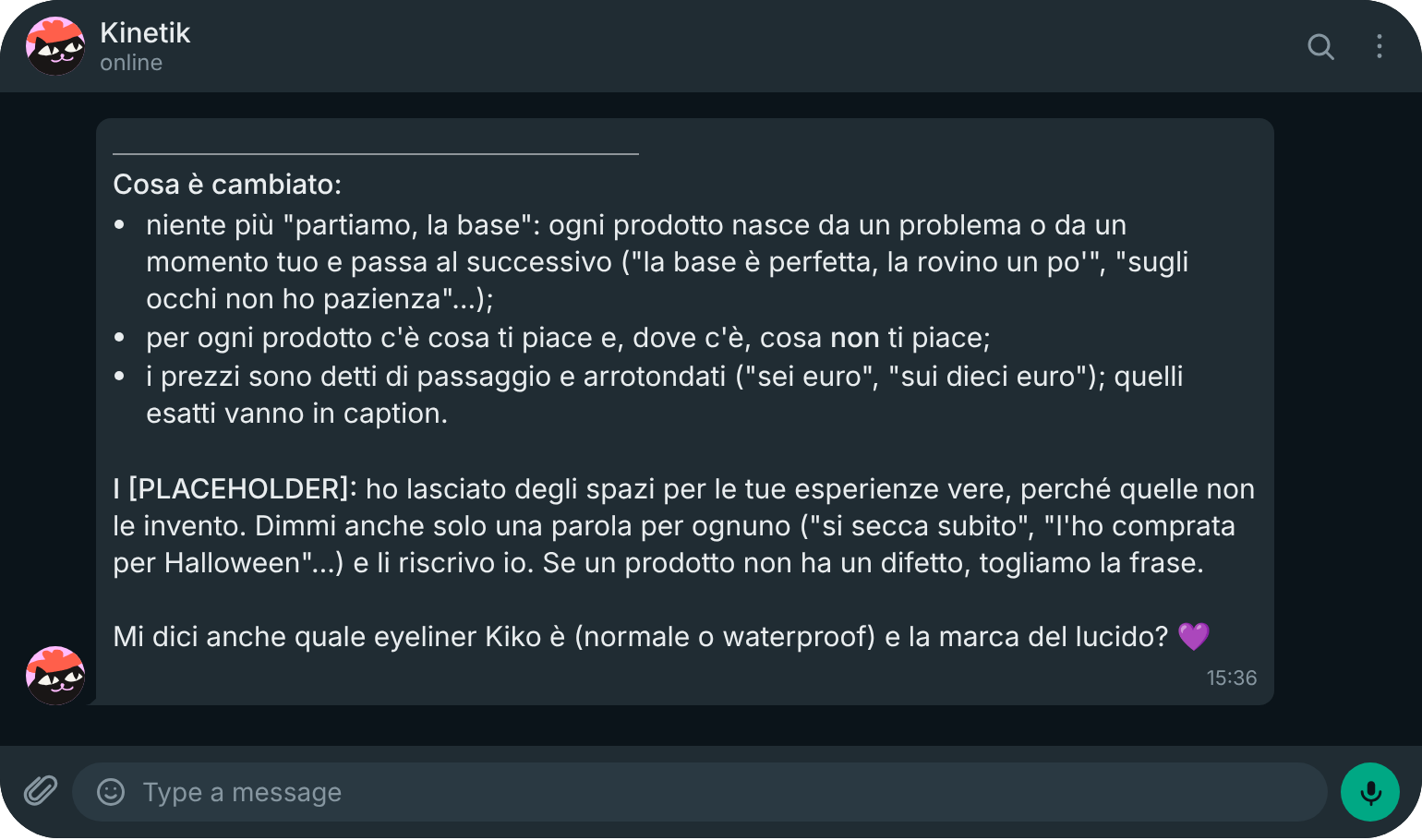 Kinetik explains what changed and leaves placeholders for Mayra's real experiences instead of making them up. (Italian)
🖊️ Team's note: how to turn half an idea into a script
1. Send the raw idea. Half a sentence, a product list, a voice note, a comment you want to answer. Format doesn't matter.
2. Set the format. Tell Kinetik how the video should feel: a GRWM, a video call with a friend, a rant, a tutorial. Mention the platform and length.
3. Ask for facts to be checked. If the script names prices or products, ask Kinetik to check them on sites in your country, like it did for Mayra.
4. Push back on the first draft. Say what feels off ("too salesy", "not my voice"). Kinetik rewrites it and remembers the preference for next time.
5. Fill the placeholders yourself. Kinetik marks where your own stories belong instead of inventing them. That's the part that makes the video yours.
I also use Kinetik to research makeup dupes and find alternatives worth talking about with my audience. My first dupe series started with one question: is it really worth spending 44 euros on a blush? I asked Kinetik to find a more affordable dupe for Rare Beauty's blush. It searched online, suggested a couple of well-known alternatives, and identified the e.l.f. one as one of the closest matches. That's the one I chose to investigate. Before buying anything, I checked the recommendation myself: the actual price, how similar the product really is to Rare Beauty's, and whether the comparison made sense. I was going to buy it with my own money and say it on camera, so I wanted the recommendation to hold up in real life, not just trust the AI.
The same video got around 5,000 views on TikTok and 2,000 on Instagram. I never expected YouTube to be my strongest platform. It taught me to test content everywhere instead of assuming I already know where it will work.
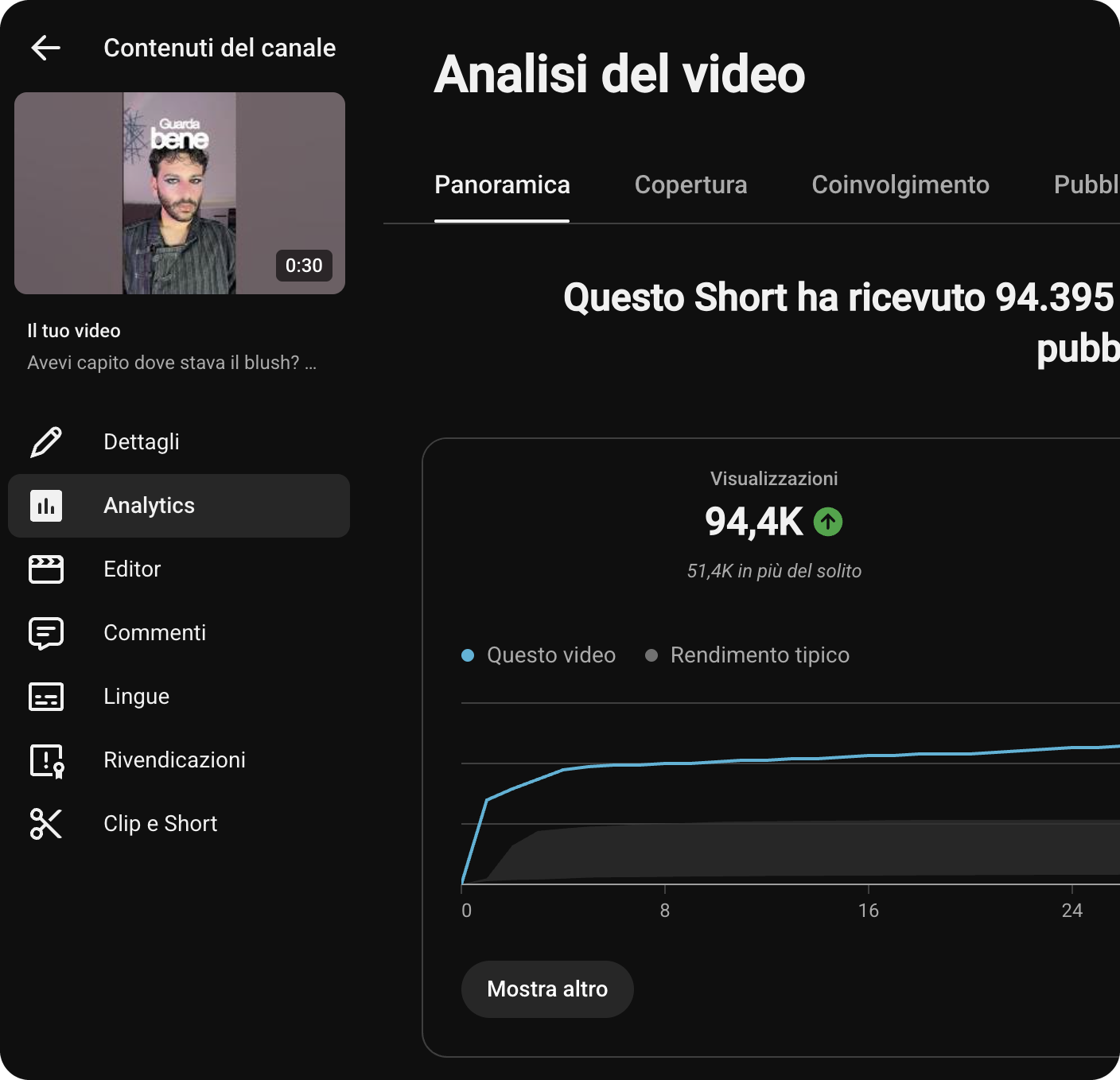 YouTube Studio analytics for the dupe video: 94.4K views, 51.4K more than usual. (Italian)
🖊️ Team's note: from a product question to a dupe video
1. Start with a specific question. Name the product, your budget and your country: "Find a cheaper dupe for Rare Beauty's blush, available in Italy."
2. Ask for a shortlist with reasons. Request current prices, shades, finish and why each option is a close match.
3. Verify before you buy. Check prices and details yourself. Kinetik does the searching; your name is on the video.
4. Turn it into a script. Ask Kinetik to build the comparison video around your test, with placeholders for your own verdict.
5. Publish everywhere and compare. Post across platforms. Mayra's best result came from the platform he least expected.
The Notion-connected calendar is amazing. It lets me organize my brands, videos and collaborations in a way I never thought possible. I can see everything at a glance: what I need to film, who I'm working with, and when everything goes live. It's such a relief, because I used to keep everything scattered across different notes.
In October I managed three brand collaborations at the same time. Before, I could handle only one.
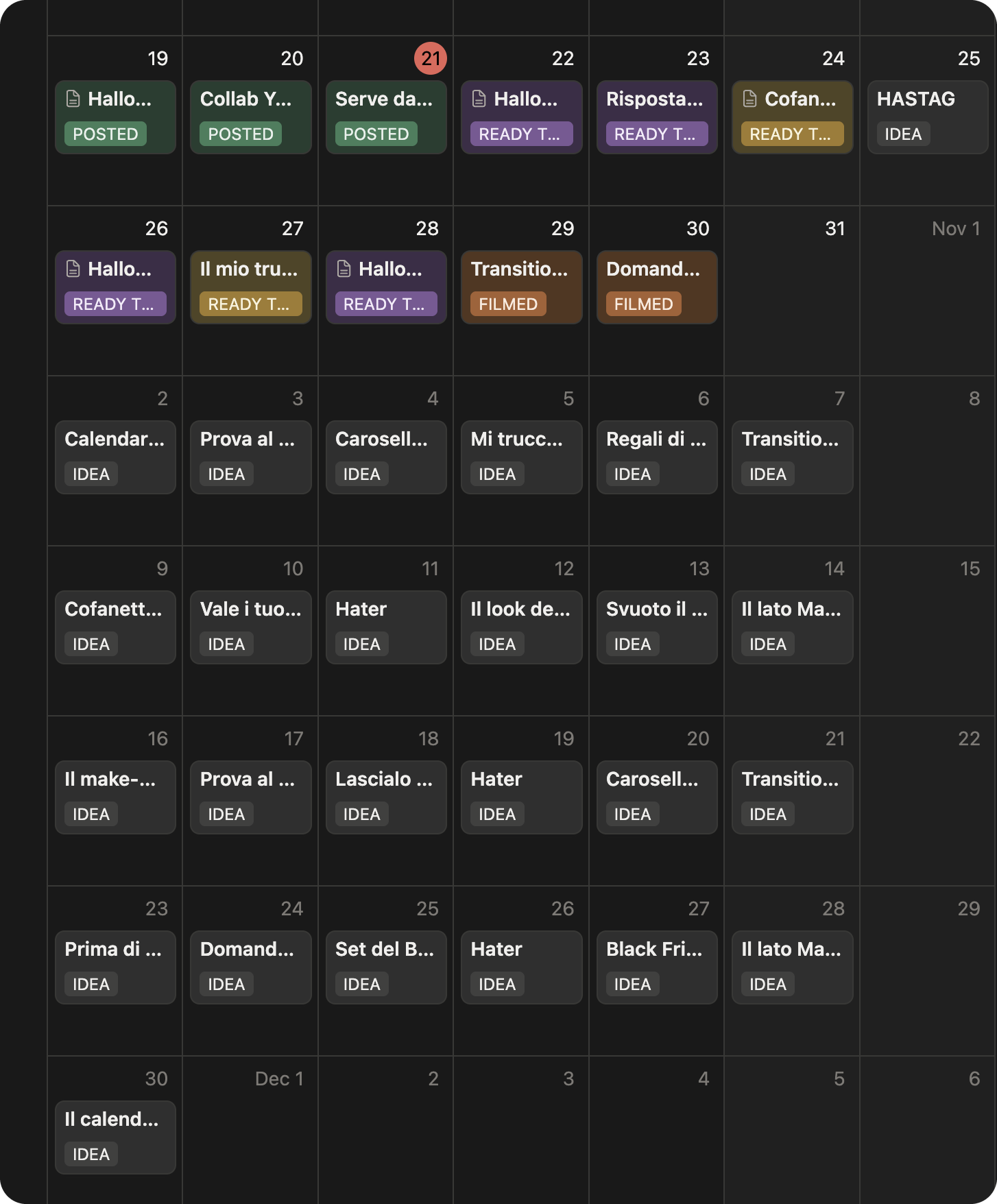 Mayra's content calendar in Notion with statuses: posted, ready to publish, filmed and idea. (Italian)
🖊️ Team's note: how to set up a content calendar in Notion with Kinetik
1. Connect Notion once. Ask Kinetik to connect your Notion and approve access. No passwords in chat.
2. Describe what you track. Videos, brands, collaborations, deadlines, statuses ("idea → filmed → ready → posted"). Kinetik sets up the calendar for you.
3. Talk to it, not to the table. "Move the dupe video to filmed", "add the new brand deal for the 15th". Kinetik updates Notion for you.
4. Ask for the week ahead. Kinetik reads the calendar and tells you what to film and what goes live next.
I tried a new format: a monthly beauty news carousel, "What's happening in the makeup world this month." I struggled with Kinetik's carousel feature, because it was hard to get slides that looked cohesive and still matched my personal style. I changed layouts, fonts, text and the amount of information so many times that every slide ended up looking different. In the end I put it aside and finished the carousel in Canva.
I was told the carousel feature has since been updated. I haven't tested the new version yet, so I can't say whether these issues are fixed, but I'm looking forward to trying it again. There are also things I wish Kinetik could do. I'd love it to analyse my videos in depth and give me actionable feedback: where viewers lose interest, whether my hook is strong enough, which topics bring the most engagement, and how my script, pacing or visuals affect retention, with specific changes for my next video. And it would be great to see how many followers each video brings in.
🖊️ Team's note: what's changed, and what's next
Carousels. Since Mayra's test, carousels have been rebuilt. You can now give Kinetik your style once (your fonts, colours and a few of your past posts), and it saves it as your design system, so every slide of every carousel follows the same rules. You can then edit any slide without breaking the rest.
Canva. You can connect your Canva account to Kinetik, so it works with your own brand templates and exports finished designs.
Video analysis. Deep retention analysis (where viewers drop off, how strong the hook is) isn't there yet. Today, connect your Instagram or TikTok, and Kinetik compares your posts by topic and format and suggests what to make next. We hear Mayra's wish loud and clear.
For me, the biggest win is the time I save on research and planning, so I can focus on the creative side: filming, testing products, and making content that feels authentic to my audience. That's the part that matters, especially when your content is a conversation about who gets to wear makeup.
Kinetik helps me organize my ideas, research, and workflow, but the creative vision, storytelling, and final decisions always come from me. For me, AI isn't about replacing creativity, it's about giving me more time and freedom to express it.
I genuinely feel supported, almost as if I have an extra member on my team working alongside me every day. I would absolutely recommend Kinetik to any content creator who wants to stop improvising and start working with a real system and method behind their content.
Send Kinetik half a sentence of your next video idea, and see what comes back. Try Kinetik ↗
About the creator
Mayra is a beauty content creator in Italy who makes makeup content without gender boundaries and turns online hate into educational videos. Follow him on Instagram (@mayralux__) ↗ and TikTok (@mayralux_) ↗.
Viktoriia ErmakovaCommunity managerNov 10, 2026
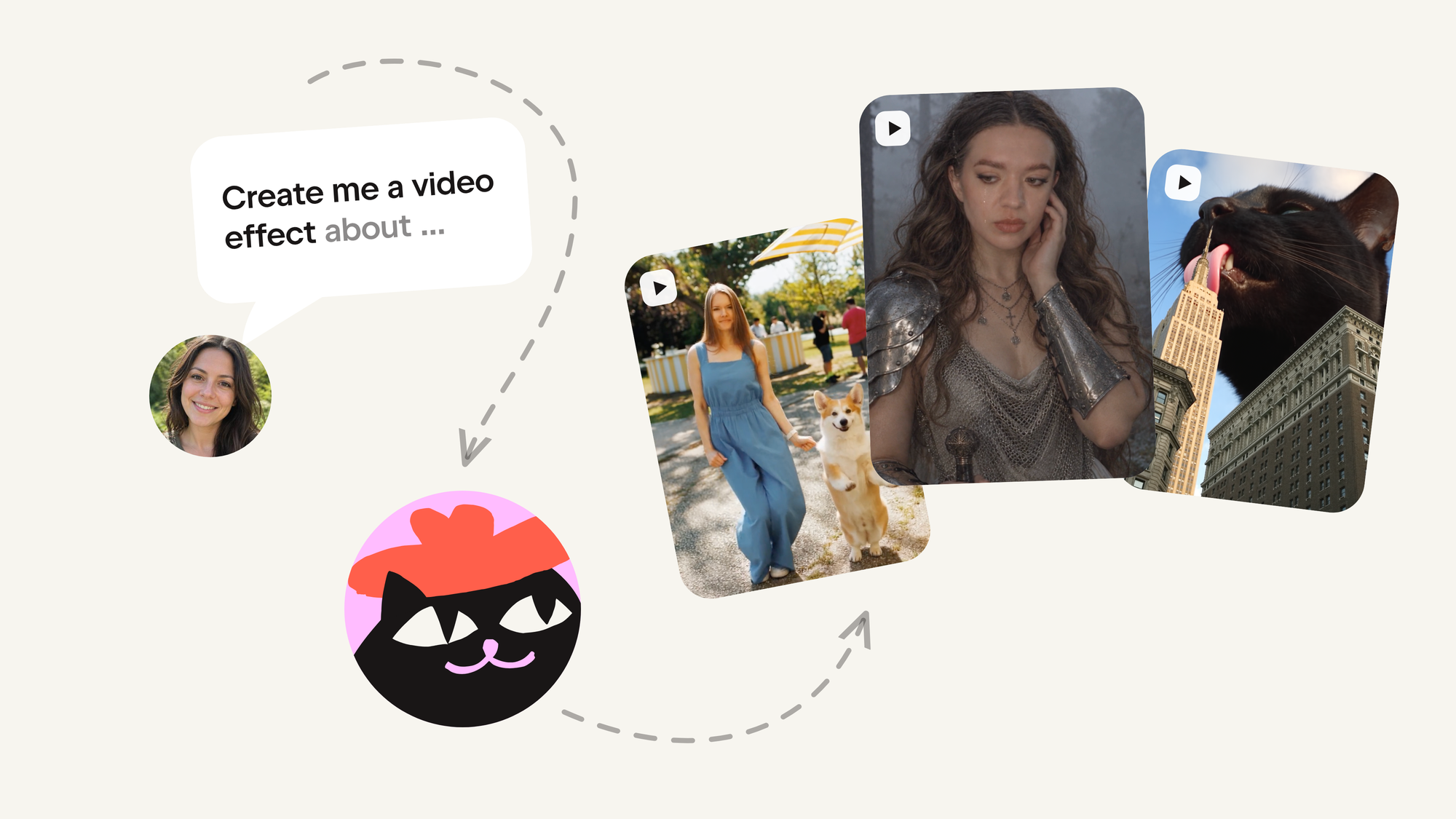
Build your video effect in Kinetik, and we'll put it in front of everyone
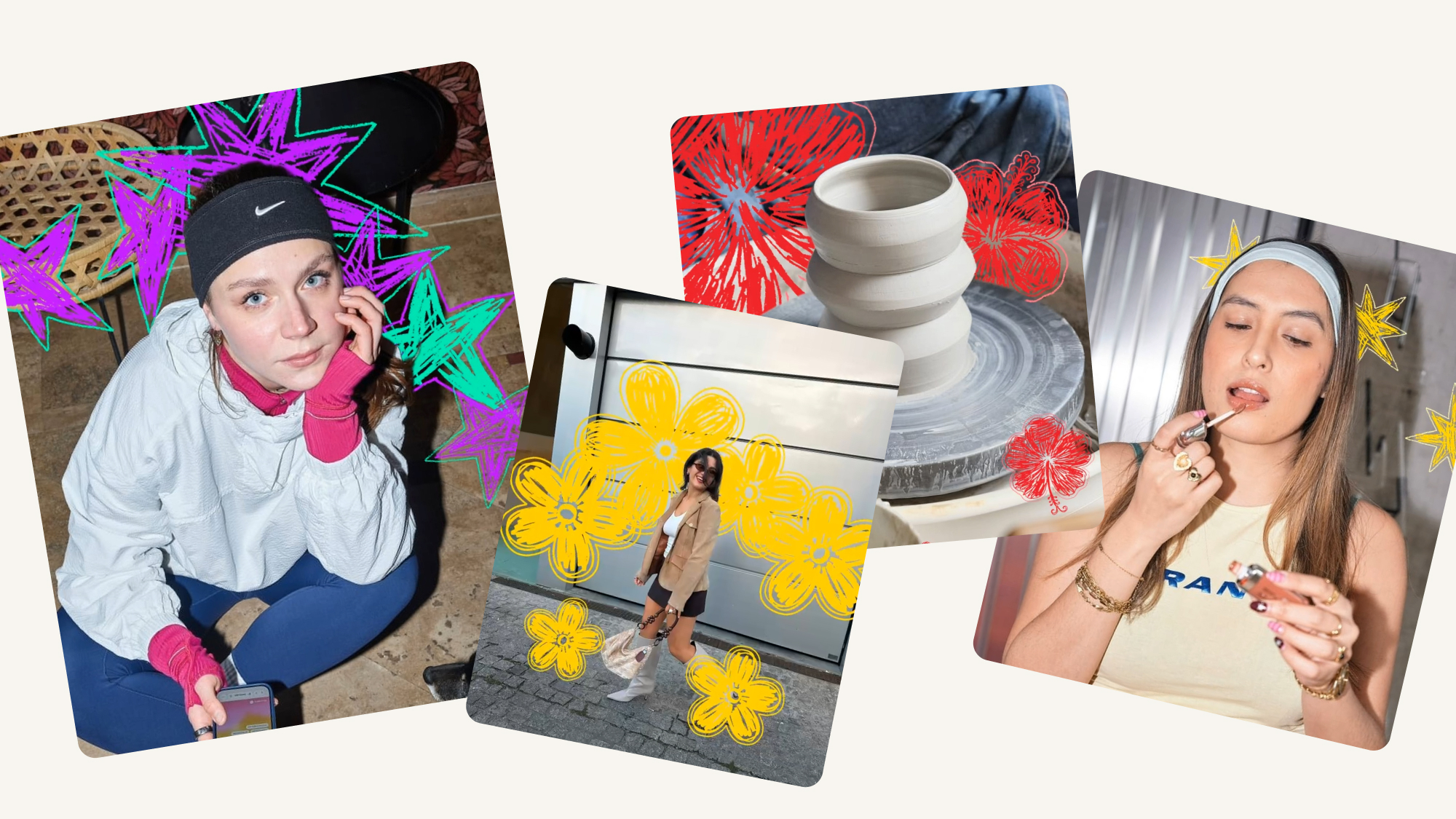
Send a photo with the words "Animate my photo," and Kinetik brings it to life.
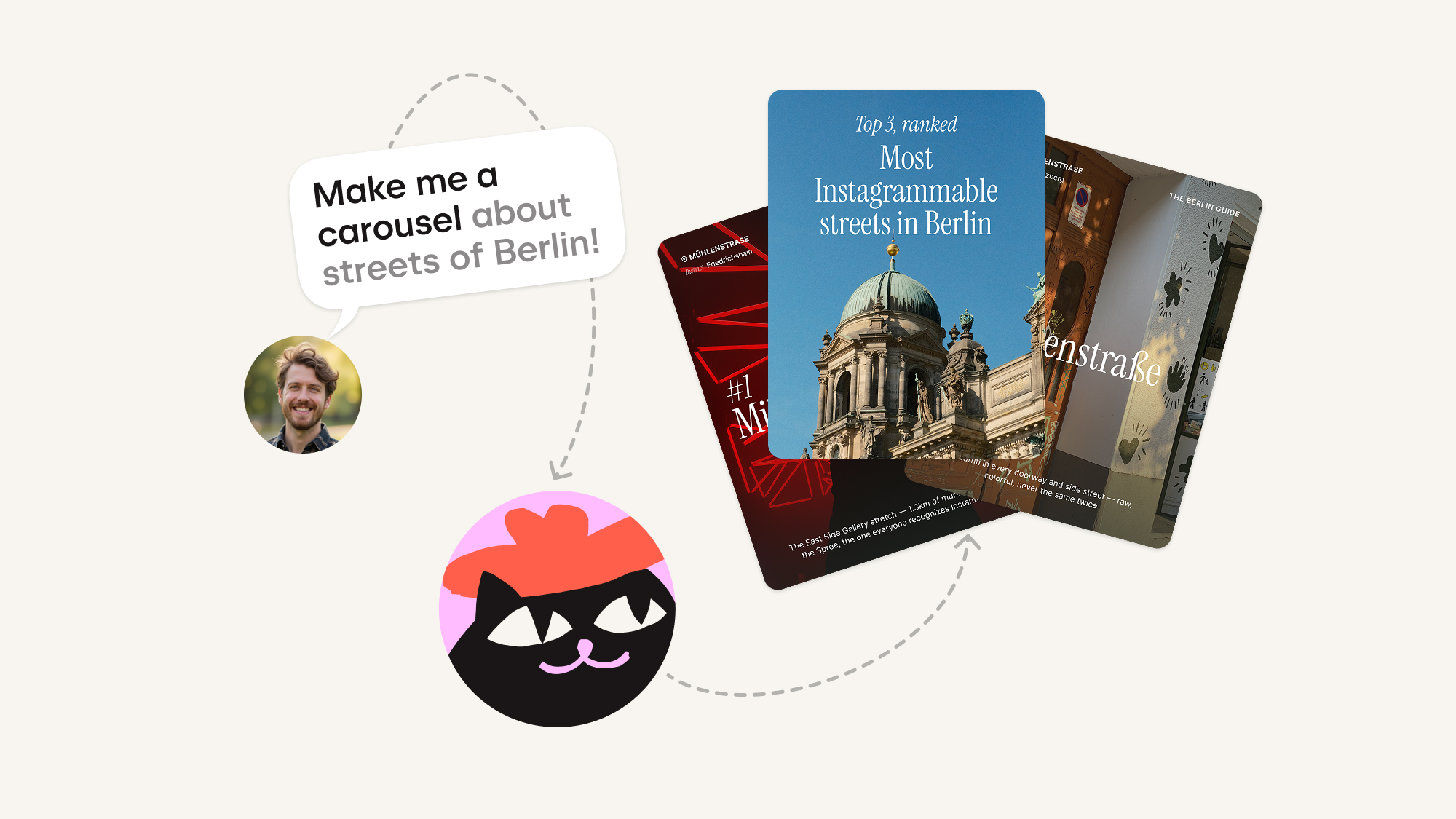
Bring a topic, and Kinetik writes the slides, chooses the images, and lays out the whole set — you just review, tweak, and publish.
AI did not just make coding faster. It moved the line between what you buy and what you build. Everything teams still rent from vendors on top of their own data now takes a few hours to build — and gets customized for you, not for somebody else's roadmap.